Significant Importance
Who is goddess Bala Tripura Sundari? Why is she not given significant importance like other gods?

From Neolithic times until 1,500 years ago, veneration of the Great Mother was widespread across the globe; however, over the past fifteen centuries, many cultures have gradually lost their traditions honoring the Divine Mother. India stands out as a notable exception, where the wisdom of the Goddess has been remarkably preserved; yogic lineages continue to honor the Goddess, maintaining traditions from ancient times. Among the many great yogic goddess lineages, Lalita’s is particularly prominent. Lalita, a self-willed and independent goddess, is exquisitely sensuous and known as Kameshvari (“Empress of Desire”). Simultaneously, she is the devoted wife of the Supreme Lord Shiva, who embodies pure consciousness. She embodies a state of perfect harmony, ever benevolent, her eyes filled with compassion for all beings.
When our senses are offered to the Goddess and our thoughts are directed to the Divine, our life becomes sweet and fragrant.
Parabrahma Maha Siddha Guru Managurunathan
Lalita is portrayed in the yoga tradition as a voluptuous young woman holding five arrows made of long-stemmed flowers, a bow made of sugarcane, a noose, and a goad. A sugarcane bow is our backbone / Spinalcord. The arrows are our five senses and the bow with which they’re dispatched is our mind. When our senses are offered to the Goddess and our thoughts are directed to the Divine, our life becomes sweet and fragrant. But when we find ourselves pausing on the spiritual path, distracted by one thing or another, Lalita gently prods us along with her goad. If we resist her mild suggestion that it’s time to move forward in our spiritual unfoldment, she lassos us with her noose and drags us, like misbehaving children, back to her lap. From this perspective, life’s worst traumas are Lalita’s lariat; it is the fullest expression of her love for even her most wayfaring children.
Bala Tripura Sundari is one of the most secret deities of the Siddhas. She is known by many names like Valaiyamman, Valai Thai, Valai Parameshwari, Manonmani. Bala Tripura Sundari means the most beautiful child of the three worlds.
“Bala was created to destroy negativity. There was a demon who received a boon that he could not be killed by a king or God, and he gave a list of people who could not kill him. There was no young girl on the demon’s list because he thought that he would not be killed by a young girl. So the Goddess tricked him and became a young girl. That is Bala and she killed him, and established an incredible life for human beings.”
She is depicted as a 9 year old, or sometimes a 16 year old virgin and is referred to as the vital breath of her own mother, Lalitha Tripura Sundari, by Lalitha herself in scriptures. The vital breath is the prana, or life force energy of the Goddess, from which her power originates.
She is thus considered to be a supreme Goddess of the preeminent Sri Chakra and Sri Vidya worship. The Sri Chakra is said to contain the power of all the Goddess principles which she rules over.
It is easy to see why then that the Siddhas teach that this Goddess is the one who is capable of bestowing unmatched blessings as well as the one who gives you all the siddhi powers, which are the supernormal abilities latent within you. They further say that unless you have the grace of this almighty Goddess, you will not be able to acquire the higher siddhis and become an accomplished Siddha.
The Siddhas have unique worship methods for her that have been kept hidden to protect the teachings from falling into the wrong hands, which are targeted to invoke her unmatched blessings of ultimate wisdom, knowledge, wealth, ability to manifest, and the highest bala tripura sundari powers.
This initiation into Bala Tripura Sundari is considered to be extremely precious and highly sought after by Yogis and Siddhas because of its potential to give you the supreme power of the Goddess.
THE GLORY OF LALITA
The deep inner significance of Lalita’s play with her devotees (her name means “she who plays”) is revealed in the Brahmanda Purana, a thousand-year-old text from South India. In the most famous section of this text, called “The Glory of Lalita,” the following mystical tale unfolds.
Shiva, lord of the universe, was engaged in ascetic practices, absorbed in deep meditation, when he suddenly felt a flush of lust. Though two of his eyes remained shut in serene contemplation, his third eye flickered open, looking for the force which had disturbed his concentration. Sure enough, there was Kama, the god of love, grinning playfully, having just unleashed an arrow of desire. Instantly a laser-like bolt arced from Shiva’s open eye, incinerating Kama. The eyelid fluttered shut and the lord resumed his meditation.
From the ashes of love arose the demon Bhanda, flaming with desire for power, wealth, and sensual indulgence. Bhanda had an extraordinary power: whenever he made war on an enemy, half his opponent’s power would be transferred directly to Bhanda.
Bhanda quickly became a mighty king, conquering a vast dominion. The sage Narada appeared to the gods to warn them of the increasing threat Bhanda represented. “You must worship the Divine Mother Lalita,” he said, “for only she can help you ward off this menace.”
Alarmed, Indra, the king of the gods, made his way to the Himalayas to perform penances in order to gain the inner strength necessary to defeat Bhanda. On a bank of the Bhagirathi River, “blooming profusely with every kind of splendid flower,” Indra worshiped the Mother of the Universe.
The Guru of Demon’s Sukra noticed what Indra was up to and rushed to Bhanda’s court where all Venusian pleasures were extravagantly indulged to alert the demons. Quickly assembling an army, Bhandasura hurried to the Himalayas to disrupt Indra’s penance, but seeing the demons coming to disturb her divine son’s meditation, the Mother of the Universe instantly threw up a protective barrier. With considerable effort, the demons smashed the wall but the moment it crumbled, another bulwark appeared in its place. The demon army tried again and again, but defensive walls continued to materialize out of the ether.
Meanwhile Indra called the rest of the gods together and announced, “Bhanda’s army is so powerful there is no way we can defeat him on our own. We will have to dig a fire pit a mile long and propitiate the Goddess with human sacrifice.” So they lit a great fire and offered a human body, as they chanted the mantras sacred to the Mother of the Universe.
A circular mass of blazing light materialized over the fire. At the center of the shining wheel sat the Great Goddess, resplendent as the rising sun. The gods recognized Lalita immediately: she was the life force of the entire cosmos, the quintessence of beauty and desire, adorned in robes the color of pomegranate, smiling at them with a loving glance as cool as moonlight. In her four arms she held a noose, a goad, a sugarcane bow, and five arrows tipped with flower petals.
What is the text saying? To those initiated in the yoga tradition, the meaning is clear. It isn’t possible to annihilate the force of desire within ourselves, because this force arises from Kameshvari, the Empress of Desire who is none other than the Mother of the Universe herself. Attempting to suppress his desires, Shiva tried to obliterate Kama, god of sexual desire, but another powerful entity instantly took Kama’s place. Unlike Kama, who represents the sacred movement of nature to cherish others in order to reproduce itself, Bhanda represents distorted, aggressive, selfish lust.
As long as we remain in the fortress of the Yogic state beyond thought and desire, the Divine Mother protects us from the onslaught of negative thoughts of Asuras with our own anti-Divine impulses.
Parabrahma Maha Siddha Guru Managurunathan.
Indra, “he who attains mastery through control of the senses,” resorts to the Himalayas to do spiritual practices which will restore a healthy, God-centered lifestyle. In yogic literature a mountain often represents the spinal column, which remains upright and unwavering in meditation, unshakable as the Himalayas themselves. On the bank of the Bhagirathi River, where Indra does penance, is the mouth of the sushumna, the subtle nerve current which is the conduit for kundalini, beginning at the base of the spine and emptying into the brain. The “flower-strewn” city where Indra meditates is the sahasrara chakra, the thousand-petaled lotus at the top of the brain. Holding his consciousness in this highest chakra, Indra enters nirvikalpa samadhi, the deepest state of meditation, where he becomes impregnable. The Divine Mother protects him from the onslaught of the demons—his own anti-divine impulses—so long as he remains in this fortress, a yogic state beyond thought and desire.
But it is not Indra’s destiny to sit withdrawn in meditation for the rest of his life. His dharma, or life purpose, is to rule the gods—that is, to rule his inner divine powers so that he can act successfully and beneficently in the world. So he mentally summons all his internal energies to make the supreme sacrifice, the one form of human sacrifice which is genuinely spiritually effective: offering every cell of one’s own body into the fire pit of kundalini. Then, having purified himself physically, emotionally, and mentally, Indra becomes fit for the vision of the Mother of the Universe, the Supreme Power of Consciousness herself. She—the source of universal consciousness—is seated in a luminous orb just above the thousand-petaled chakra at the top of the head.
The text goes on to say that at the sight of the Power of Consciousness, the soul and its inner senses fly into ecstasy. Smiling at the upturned faces of the enraptured gods, which glowed with the reflection of her own light, the Goddess said, “My dear ones, be joyous! I will remove your fear. I bless all of you with virtue, prosperity, and fame, and with loving spouses, devoted children, and trustworthy friends.”
Hearing that the Mother of the Universe was manifesting in a visible body, sages and cosmic intelligences like Brahma the Creator rushed to the scene. Catching a glimpse of the Mother’s supremely beautiful face, and seeing the magnificent city which the cosmic architect Vishvakarma had instantly built for her, Brahma thought, “It is no more appropriate for a woman to rule such a city alone than for a king to rule a kingdom without a queen. The Supreme Goddess must have a husband, but who in all these worlds is worthy of her? Only Lord Shiva himself, but he sits in meditation, naked as pure universal consciousness, so she may not accept him.”
Sensing the Creator’s thoughts, Shiva materialized before Brahma’s eyes. For this special occasion, the lord of the universe assumed a stunningly handsome form, draped in gorgeous robes and gems. Then Shiva turned to look at the Goddess. Shiva, the ascetic god who had incinerated the force of lust, found himself melting like butter in the hot sun before the bewitching beauty of the Mother of the Universe, who embodied in herself the very essence of sexual power.
Smiling, Lalita announced, “Whatever I say or do is according to my own will alone. Whichever man accepts me as his wife must also accept my complete independence.” Saying this, she pulled the garland from her neck and tossed it into the sky. It circled the heavens before finally landing around Shiva’s neck. In this handsome, garlanded form Shiva became known as Kameshvara, “the Emperor of Love.” He and Lalita were immediately united in marriage, to the great delight of the assembled deities.
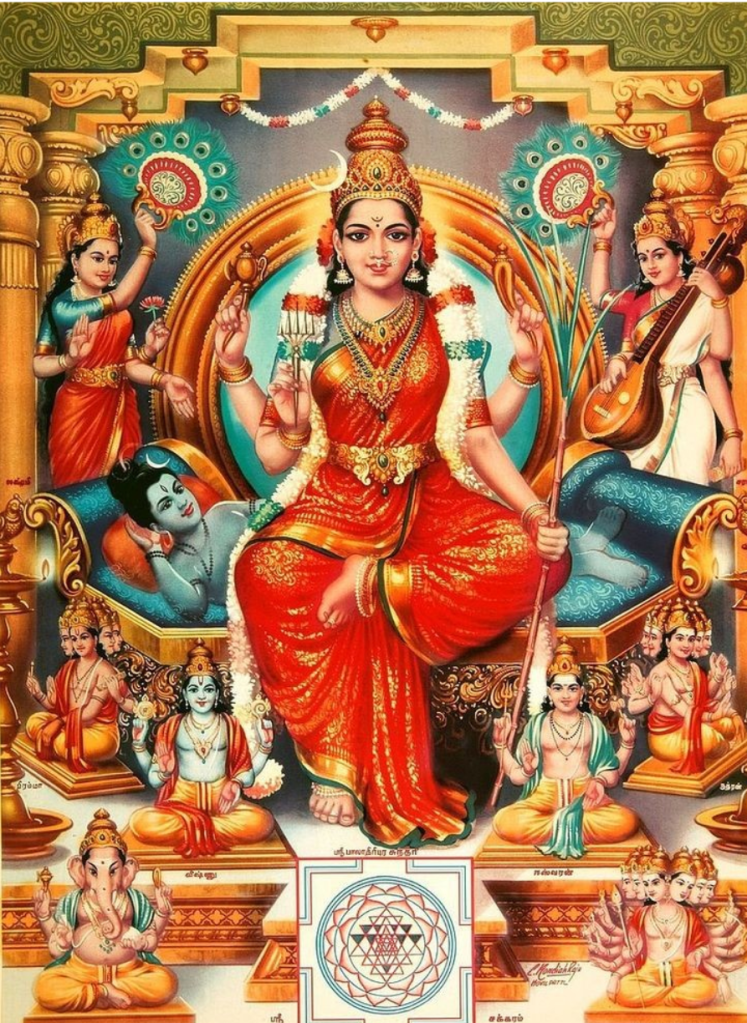
There was no honeymoon. The Divine Mother had promised to free the gods from fear, so immediately she set out to meet Bhanda in battle. The Brahmanda Purana lovingly describes the powerful military commanders who accompanied her, all awesome and intelligent shaktis, demi-goddesses eager to free the world from evil, riding in extraordinary chariots the likes of which had never been seen on earth. This section of the scripture too is entirely yogic: the shaktis are the innate energies of the subtle body, and their chariots are the yantras or sacred mandalas in which these energies embody themselves when yogis worship their yantras with reverence.
When Bhanda heard that an army of women was approaching his city, he howled with laughter. His younger brother soberly cautioned, “It is Shakti (divine power) which gives every victory. We have reason to fear anyone who becomes a seat of that energy. Don’t underestimate these attackers because they are women. Remember the goddess Kali is the fiercest warrior of all. Let’s find out who these women are before we counterattack.” But Bhanda could not be persuaded; after all, he could effortlessly draw into himself half his enemy’s strength. Who could possibly defeat him?
THE INNER BATTLE
The author of the Brahmanda Purana details the ensuing rout, as the women warriors decimate Bhanda’s clueless male troops. Every phase of the battle represents a stage of spiritual self-purification. In one episode, for example, the demon general Balahaka overcomes Lalita’s shaktis with a boon he long ago received from the Sun God. Whenever he looks at an enemy with anger, rays of hot light shoot from his eyes, paralyzing his opponent. Seeing many of the shaktis overcome by this force, the demi-goddess Tiraskaranika covers his eyes with an impenetrable veil. While he staggers in confusion, she lops off his head. In case anyone has missed the purport of the allegory—that anger is such a debilitating force it can defeat even the purifying energies of the Higher Self—the author pointedly explains that it was actually Balahaka’s own temper which blinded him.
Bhanda turned to his chief sorcerer for help. Grinning maliciously, the sorcerer prepared a special yantra, a geometric design infused with curses, and hurled it into the camp of the shaktis. Suddenly the demi-goddesses, always eager to serve Lalita, found themselves giving in to lassitude and despair. “Why should we fight injustice in the world? What difference will all our self-sacrificing efforts make in the end? We’re throwing our lives away for nothing. And why should we practice such strict self-disciplines? We’re not going to become enlightened in this lifetime anyway. Why not relax and enjoy life a little? Let’s get some sleep.”
Many times in life we too have been hit by despair and failed
Of all the shaktis, only the two supreme commanders, Dandanatha and Mantrini, were so firmly established in their spiritual practices that they remained unaffected by discouragement or sloth. They hurried to Lalita to report, “Empress, the demon army is attacking and our warrioresses are sleeping!”

Lalita was not in the least distressed, but began to laugh! From her beautiful peals of laughter a huge, ungainly form began to coalesce. He had the muscular body of an extremely strong but quite corpulent young man, with the head of an elephant. This is how Ganesha, the popular elephant-headed god of Hinduism, was born.
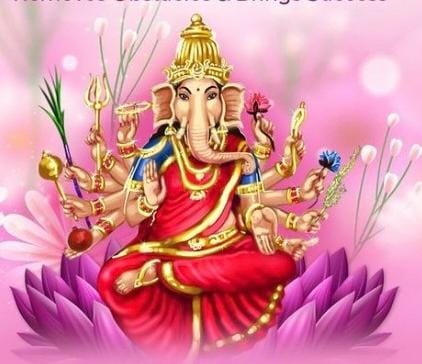
Highly intelligent like all elephants, Ganesha immediately sensed what was wrong. Pausing only a moment to bow to his mother, he quickly sprinted away to locate the evil yantra which had cast a stuporous spell over the women warriors. He found it almost immediately and smashed it to pieces with his tusk. Instantly the shaktis leaped to their feet, eager to resume battle. Lalita was so delighted with her son’s excellent service she granted him the boon that he would be worshiped before any of the other gods. That is why to this day whenever Hindus begin a worship service they always start by honoring Ganesha first.
Ganesha represents firm determination. Whenever the mind is resolute, all obstacles are overcome, enthusiasm is sustained, and victory is ensured. The root of determination is self-confidence and a sense of humor.
Parabrahma Maha Siddha Guru Managurunathan
Bhanda then decided to attack by night, a tactic completely against the code of Hindu chivalry. Noting that Lalita always sent her shaktis to fight while she herself remained hidden in the background, observing and controlling their motions, he planned to surround her in the darkness and lead the attack from behind. This surprise attack caught the shaktis off guard; many of them were seriously wounded. Then the undying cosmic intelligences who bask eternally in Lalita’s glow drew their bows of prana (breath or life energy) and staved off the onslaught. Injured women warriors were carried into Lalita’s presence, where a loving glance from her eyes, ever moist with mercy, instantly healed their wounds.
The text is warning that selfish desires and self-defeating impulses can invade even the more advanced states of meditation. When these distractions are experienced, the seeker is advised to practice pranayama, breath control, to still the disturbances in the mind. And if at any time one feels frightened or defeated, withdrawing one’s awareness and placing oneself fully in the light of the Goddess, the divine consciousness within which is the source of all healing power, will restore one’s faith and energy.
Parabrahma Maha Siddha Guru Managurunathan
Mantrini and Dandanatha, Lalita’s two generals, were concerned at the near success of Bhanda’s last assault, and analyzed their defensive strategy carefully. They quickly saw, and repaired, weak areas in their bulwarks.
representing those aspects of our personality with which we subvert our best efforts. All parts of our being must be balanced and in harmony if we are to avoid defeating ourselves. The further one progresses in spiritual life, the higher the stakes become. Vedic literature is replete with stories of great yogis who advanced to high stages of spiritual practice, only to tumble to subhuman levels because some shadow in their mind had never been exposed to the light of self-awareness.
Mantrini and Dandanatha decided to protect their forces with a rampart of blazing fire. Only a tiny gate would be allowed in the rampart, where the Goddess’s troops could come and go. The entrance would be guarded day and night by powerful shaktis who never sleep. Thus the abode of the Supreme Consciousness was surrounded by a garland of impassable flames.
This ring of fire is often mentioned in yogic literature, where it has been described variously as a golden disk concealing the innermost truth, a shining beacon many glimpse at the time of death (and through whose blazing light only enlightened souls can pass), or the Inner Sun. This is not a metaphor but a literal experience reported by many advanced meditators, who claim it is like looking into the combined light of a thousand rising suns. The holiest of all verses in the ancient Vedas, the gayatri mantra, invokes the enlightening wisdom of this very experience. “We meditate on the Inner Sun, the most splendid light in all the worlds. Please illumine our hearts and minds, and make our lives radiant!”
The entrance to the realm beyond this light is said to be accessible to those who never sleep. Under laboratory conditions, yogis have demonstrated the ability to remain fully conscious, aware of everything occurring in the room around them, while scientific instrumentation unambiguously shows that the yogi’s body (including his brain) is in a state of deep sleep. The ability to remain lucid not only during dreams but even in deep sleep is one of the powers the Goddess grants advanced meditators in the yogic tradition.
Discover more from SRI VIDYA SRI PEEDAM TRUST
Subscribe to get the latest posts sent to your email.
mujhe iski baut jarurat thi
Everything will be fine and good forever ✨️
Pingback: ஸ்ரீ பாலா திரிபுர சுந்தரி தேவியின் முக்கியத்துவம் – SRI BALA SIDDHASHRAM