Secrets of Ganapati: Tantric Anatomy

Sri Ganesha – The Lord of Cosmic Intelligence and Remover of Obstacles
Sri Ganesha is revered as the remover of obstacles and the divine guide. Beyond his beloved elephant-headed form lies a profound spiritual truth: Ganesha represents the cosmic intelligence that governs the universe and leads seekers toward the Supreme Reality.
Invoked at the beginning of all sacred rituals, Ganesha aligns us with auspicious energies and guides our actions toward success and harmony. His name, Ganapati or Ganesha, means “Lord of the Ganas.” These Ganas symbolize not only beings and creatures but also the energies, senses, life-forces (prāṇas), mantras, elements (tattvas), and karmic forces that shape existence.
As the ruler of these cosmic principles, Ganesha gathers and harmonizes all aspects of life, directing them toward higher consciousness. He is the lord of karma, the intelligence that governs the results of our actions. When we align ourselves with his wisdom, our efforts become more purposeful, balanced, and fruitful.
His sacred mantras, Om Gam Ganeshaya Namah and Om Gam Ganapataye Namah, invoke his blessings, protection, wisdom, and guidance on the spiritual path.
Ganesha’s Guiding Power
Ganesha is the first of the gurus who guides us. He is invoked at the beginning of all Hindu rituals as he aligns us with the benefic powers of the universe. Ganesha’s vehicle, the mouse, indicates his respect for all creatures great and small.
Gana means a group and Isha or Pati means the lord, Ganesha, Ganapati. The Ganas on an outer level are all the animals of which Ganesha as the elephant is the ruler or chieftain, but this is just the surface.
The animals indicate the different souls and energies bound to the world of Samsara. Ganesha gathers them together under his guidance and offers them to Lord Shiva as the highest awareness.
The Ganas are the letters or mantras of Sanskrit and Ganesha as OM is their ruler. The Ganas are the pranas and sense organs, and Ganesha as the inner self is the foremost. The Ganas are the tattvas, or universal truth principles, starting with the five elements, of which Ganesha as the inner self is the pivot.
The Ganas are the events and rhythms in time as the movement of karma. Ganesha is the lord of karma, the cosmic intelligence that dispenses the fruits of our actions.
If we ally our actions with Ganesha, all that we do will achieve the best results. His guiding power is represented by his mantra GAM, OM GAM Ganeshaya Namah! and by OM GAM Ganapataye Namah!
Secrets of the Shatadhara
The ancient wisdom of Ganesha reveals far more than the worship of a deity—it unveils a profound map of spiritual awakening. Ganesha’s unique form is a symbolic representation of the journey toward self-realization and the mastery of the six psychic energy centers (Shatadhara): Muladhara, Swadhisthana, Manipura, Anahata, Vishuddhi, and Ajna.
Every aspect of Ganesha’s form carries spiritual significance. His single tusk symbolizes one-pointed concentration, his large ears represent deep listening, his small mouth teaches restraint in speech, and his large belly signifies the capacity to embrace all experiences. The axe (Ankusa) cuts through ignorance and karmic limitations, while the rope (Pasha) guides and disciplines the seeker on the spiritual path. His mouse vehicle symbolizes the restless ego and desires that must be brought under the control of wisdom.
At a deeper level, Ganesha is the guardian of the Muladhara Chakra and the cosmic intelligence that governs the awakening of consciousness through all the psychic centers. His symbolism teaches that true spiritual growth comes through purification, self-mastery, disciplined energy, and inner awakening.
The Secrets of Ganesha and Shatadhara reveal that the Divine resides within every individual. By understanding and meditating upon Ganesha’s sacred symbolism, seekers can harmonize their inner energies, overcome obstacles, awaken higher consciousness, and move toward spiritual realization.
Ganesha and Shiva: The Mystery of Divine Consciousness
Sri Ganesha is revered as the son and representative of Lord Shiva, embodying the divine intelligence that governs the manifested universe. While Shiva represents pure, transcendent consciousness beyond all forms and limitations, Ganesha represents that same consciousness actively guiding creation and life.
In relation to the sacred sound Om, Shiva symbolizes the unmanifest and eternal reality beyond creation, while Ganesha represents the manifest power of Om operating within the cosmos. Through the mantra Om Gam Ganeshaya Namah, seekers invoke this cosmic intelligence to bring wisdom, clarity, and harmony into their thoughts and actions.
One of the most profound stories in Hindu tradition is the beheading of Ganesha by Shiva and the replacement of his head with that of an elephant. Far from being a literal event, this sacred symbolism points to a deep spiritual transformation. The human head represents the limited ego, personal identity, and conditioned mind. The elephant head symbolizes expanded awareness, wisdom, strength, and universal consciousness.
Through Shiva’s grace, the individual soul transcends its narrow identification with the ego and awakens to a higher state of being. The story teaches that spiritual evolution requires the surrender of limited self-awareness and the rebirth of consciousness into a greater cosmic reality.
Thus, Ganesha represents the journey from individuality to universality, from ego to wisdom, and from human limitation to Divine Consciousness. He stands as a symbol of inner awakening, spiritual rebirth, and the realization of the unity of all existence.
Ganesha and Shakti: The Union of Divine Consciousness and Power
In the yogic tradition, Sri Ganesha is not only the son of Devi Parvati but also the living expression of the union of Shiva and Shakti. He embodies the highest awareness of Shiva while manifesting the dynamic power of Shakti, making him the perfect guide for spiritual awakening and transformation.
Ganesha resides in the Muladhara Chakra, the root energy center that governs stability, grounding, and the Earth element. It is here that the dormant Kundalini Shakti rests. As the guardian of the Muladhara, Ganesha provides the strength, balance, and foundation necessary for the safe awakening and upward movement of this transformative spiritual energy. His sacred mantra GLAUM is traditionally associated with stabilizing and energizing this chakra.
Ganesha is accompanied by his divine consorts, Siddhi (Spiritual Accomplishment) and Buddhi (Divine Wisdom), symbolizing that true success arises through the harmonious union of knowledge and realization. Through these powers, he grants both worldly prosperity and spiritual growth.
Revered as the remover of obstacles, Ganesha helps seekers overcome limitations, karmic barriers, and inner resistance. His grace is especially celebrated during Ganesh Chaturthi & Sankasti, when his transformative energy is believed to be particularly accessible.
The deeper secret of Ganesha is that he represents the cosmic intelligence guiding all evolution. By surrendering to his wisdom and aligning with his divine presence, one can transform challenges into opportunities, awaken inner potential, and move steadily toward the blissful realization of the inseparable unity of Shiva and Shakti.

Common Misconceptions about Muladhara
Muladhara: This center is said to be at the Perineum—the space between the anus and the genitals where Kundalini shakti, the dormant, the coiled energy or serpent energy, is understood to be lying. A key question arises regarding Muladhara, traditionally described as the seat of Kundalini and the center governed by Sri Ganesha.
If Muladhara is the root or source of consciousness, should it be identified merely with a physical location at the base of the body, or with the true source from which human awareness operates?
The word Moola means root, origin, or cause, while Adhara means support. From this viewpoint, the ultimate root of human experience is consciousness itself, expressed through the brain and higher centers of awareness.
Interestingly, the Tamil word “Moolai” (brain) shares a linguistic connection with the concept of Moola or root. This has led some Siddha masters to suggest that the true Muladhara should be understood as a higher center within the head rather than a location near the base of the spine.
Scriptural Clues
Ancient scriptures such as the Bhagavad Gita and the Katha Upanishad describe the cosmic tree whose roots are above and branches below. Similar symbolism appears in Sufi teachings, where the trees of paradise are said to have their roots in the higher realms. These metaphors are interpreted by some Siddha traditions as indications that the true spiritual root of human existence lies above rather than below.
Kundalini and the Brahma-Dvara
“Kantordhavam kundalisaktirasthitha kundalakrithi.
Brahmadwara mukham nithyam mukhenachadya thishtathi” – Gorakh Shataka
Support for this interpretation is also drawn from the teachings of the great Siddha yogi Gorakhnath. In the Gorakh Shataka, Kundalini Shakti is described as residing above the throat, covering the entrance to the Brahma-Dvara (the doorway to Divine Consciousness).
From this perspective, Kundalini is viewed not merely as an ascending force from below, but as a higher spiritual power already present in the subtle centers of consciousness. According to this Siddha interpretation, Muladhara is not merely a physical location but the fundamental source of awareness itself. The true root of spiritual awakening is understood to reside within higher consciousness, symbolically represented in the head above the throat.
Whether one follows the classical yogic model or the Siddha interpretation, the deeper teaching remains the same: spiritual evolution involves awakening the dormant divine potential within and realizing the unity of individual consciousness with the Supreme Reality.
Tantric Anatomy
Tantric interpretations of Ganesha often focus on his symbolic representation of the human body’s energy centers (chakras) and their connection to spiritual awakening. Ganesha, with his elephant head and large belly, is seen as embodying the Muladhara chakra (located at the base of the spine) and the Manipooraka chakra (at the navel), which are reservoirs of energy.
Through Tantric practices, particularly Ganapati sadhana, devotees aim to awaken these energy centers, leading to overcoming obstacles and achieving spiritual liberation.
Tantric Anatomy: Tantra views the human body as a microcosm of the universe, with various energy channels (nadis) and psychic centers (chakras). Ganesha’s form is interpreted as a map of these energy centers, with his elephant head representing supreme intelligence and his large belly signifying the reservoir of energy in the Manipooraka chakra.
Neuroplasticity: The Brain’s Power to Transform Itself
Neuroplasticity is the brain’s remarkable ability to reorganize, adapt, and create new neural connections throughout life. Far from being a fixed organ, the brain continually reshapes itself in response to learning, experience, meditation, sensory input, physical activity, and even injury.
This capacity enables us to acquire new skills, strengthen memory, recover from neurological damage, and transform habitual patterns of thinking and behavior. Every thought, emotion, action, and experience influences the neural pathways that shape our perception of reality.
Neuroplasticity demonstrates that the human mind and brain are dynamic systems capable of continuous growth and evolution. Positive practices such as meditation, mantra repetition, focused attention, conscious breathing, learning, and physical exercise can strengthen beneficial neural networks while gradually weakening limiting patterns.
From a spiritual perspective, neuroplasticity offers a scientific framework for understanding how sustained spiritual disciplines can transform consciousness.
Ancient yogic traditions have long taught that repeated practices reshape the mind, awaken higher awareness, and cultivate new ways of experiencing reality. Modern neuroscience now confirms that the brain possesses the biological capacity to support such transformation.
In essence, neuroplasticity reveals a profound truth: we are not permanently bound by our past conditioning. Through conscious practice, disciplined attention, and transformative experiences, the brain can rewire itself, opening the door to greater learning, healing, resilience, and self-realization.
Sri Vidya Perspective: While neuroscience describes neuroplasticity as the formation of new neural pathways, yogic traditions describe a parallel process as the purification of the mind (Chitta Shuddhi), awakening of inner awareness, and the harmonization of consciousness through sustained spiritual practice. Together, these perspectives suggest that transformation is both biological and spiritual.
Here’s a more detailed explanation:
Definition: Neuroplasticity is the brain’s ability to change its structure and function in response to experience, learning, or injury.
Mechanism: This involves changes in the strength of existing neural connections, the formation of new connections (synapses), and even the elimination of unused connections.
Importance: Neuroplasticity is crucial for learning, memory, recovery from brain damage (like stroke or TBI), and adapting to new situations.
Learning: When you learn a new skill, your brain creates new neural pathways to support that skill.
Recovery from injury: After a stroke, the brain can reorganize itself to compensate for the damaged area, potentially restoring lost function.
Overcoming negative patterns: Neuroplasticity allows you to change negative thought patterns and behaviors by forming new, healthier neural connections.
Factors influencing neuroplasticity: Experiences: New experiences and learning opportunities can stimulate brain changes.
Age: While neuroplasticity is more pronounced in younger brains, it continues throughout life, though it may require more focused effort in adulthood.
Environment: A stimulating and enriching environment can promote neuroplasticity, while negative factors like stress or toxins can hinder it.
Physical activity: Exercise, especially aerobic exercise, has been shown to positively impact brain structure and function, contributing to neuroplasticity.
Practical implications: Understanding neuroplasticity can be beneficial for:
Learning and memory: By engaging in activities that challenge the brain, you can enhance your learning and memory abilities.
Rehabilitation: Neuroplasticity principles are used in therapies to help people recover from brain injuries.
Mental health: Neuroplasticity can be leveraged to address negative thought patterns and promote positive mental well-being.
BRAIN 🧠EFFICIENCY
Brain efficiency is influenced by a complex interplay of factors including brain structure, neurotransmitters, hormones, genetics, lifestyle, age, and experience. These factors interact to affect how well the brain functions and adapts throughout life. Here’s a more detailed look:
1. Brain Structure: The physical organization and connectivity of neurons (brain cells) is crucial for efficient brain function. Healthy brain structure supports effective communication and information processing.
2. Neurotransmitters: These chemical messengers (like dopamine and serotonin) transmit signals between neurons. Imbalances or deficiencies in neurotransmitters can disrupt communication and impair brain function.
3. Hormones: Hormones like estrogen and testosterone play a role in brain development and function, influencing mood, cognition, and other processes.
4. Genetics: Genetic predispositions can influence brain structure, neurotransmitter systems, and susceptibility to certain conditions, impacting overall brain efficiency.
5. Lifestyle: Factors like sleep, exercise, nutrition, and stress levels have a significant impact on brain health. For example, sleep deprivation can impair cognitive function, while regular exercise can promote neuroplasticity.
6. Age: Brain efficiency naturally changes with age, with some cognitive abilities declining while others may improve.
7. Experience and Learning: The brain’s ability to reorganize itself based on experiences, known as neuroplasticity, is essential for learning and adapting to new situations
The Structure of the Brain
The head, as everyone knows, contains the brain, which is covered by the skull. The brain contains three distinct portions: (1) the cerebrum, (2) the cerebellum, and (3) the medulla oblongata.
The cerebellum is divided into two halves, the right and the left. The right half controls the left side of the body and the left half controls the right side of the body.
Cerebrum
This fact will expose the absurdity of identifying the flow of breath in the left nostril with Ida Nadi and the flow of breath in the right nostril with Pingala Nadi. Besides its manifold functions, it is the seat of memory and consciousness, covering all evolutionary stages of existence in this life as well as in the past.
Cerebellum
The cerebellum, located at the back of the brain, under the cerebrum’s posterior part, plays a crucial role in motor control, balance, and coordination. This portion of the brain regulates the equilibrium of the body and coordinates mental and physical activities.
Medulla Oblongata
The Medulla Oblongata is the smallest part of the brain, controlling the vital functions of the body, such as the regulation of heartbeat and breathing. It also controls reflex centers and is situated just below the cerebellum. It is, in fact, a spinal bulge at the top of the neck.
The spinal cord, descending from this bulge through the vertebral column, is only in the nature of a telegraph wire to carry impulses to and from the brain and other parts of the body.
Muladhara and Medulla Oblongata: If any part of the body is to be called Muladhara, it should be this portion, the base of the brain. Not base of the spine.
Etymology of Muladhara: The medulla oblongata, the neck and throat region of the body, is called Kaluthu in Dravidian Tamil and Kantam in Aryan Sanskrit.
The sacred syllable of Ganesha, the presiding Deity of Muladharam, is “Glowm or Gam”.
This sacred syllable as well as the anatomical terms such as gullet and glottis and the Sanskrit word galam for the neck are related to the Tamil word Kaluthu above which muladharam is situated.
The above delineation would amply confirm the identity of Muladhara with the Medulla Oblongata.
Ganesha and the Title of Ganapathy: Ganesha, the presiding deity of the muladhara, is also called Ganapathy, meaning “Lord of Hosts.” There is some confusion regarding this name.
During the Vedic period, Ganapathy, meaning “Lord of Hosts,” was a title. This title was adopted by Indra and later by Shiva and even by Karthikeya. Ganapathy is a corruption of Kanapathy. Ganesha, being a deity of the pre-Vedic period, was considered to be the lord of Kana, as distinct from Gana, meaning the lord of hosts.
Kana in Dravidian means sound (Nada).: The Lord of Nada was called either by the name Kanesha (Kanam meaning Nada and Esan meaning Lord) or Kanapathy (Kanam meaning Nada and Pathy meaning Lord).
Even in Sanskrit, Kwana means the sound produced by the musical instrument Veena. When Ganesha became an important deity, he appropriated the title of Ganapathy, meaning the lord of hosts, for himself, and the name Ganapathy was also added to the list of his several other names.
Ganesha as the Lord of Nada: The name Ganesha, meaning “lord of Nada,” is quite appropriate because Nada (sound) is produced from the throat region controlled by the Medulla Oblongata, which can be confirmed as the muladhara, of which Ganesha is the presiding deity.
Ganesha and Breath
Ganesha is also called by another name, Vinayaka. Vinayaka actually means lord of breath. ‘Vi’ means air, ‘Nayaka’ means lord. The air meant here is the breath of life regulated by the Medulla Oblongata.
Some interpret this name to mean one born without a sire, basing the interpretation on the Puranic story that Ganesha came into existence as the mind-born son of Parvati. Ganesha being the presiding Deity of Muladhara, the interpretation based on the science of yoga that he is the Lord of breath may be considered more appropriate.
Misinterpretation of Muladhara’s Location: Regarding muladhara, it is unfortunate that this great psychic center is considered to be situated in the anus region.
Perhaps this misconception gained ground due to misinterpretation arrived at by interpreters with meager knowledge, taking the bottom end of the spinal column instead of the top end as Muladharam.
Caduceus and Muladhara: It may be noted that the caduceus, popularly known as the staff of Mercury, the messenger of the gods, is a symbol of the flow of Kundalini Shakti from the muladhara below the cerebellum.
The eagle with spread wings, mounted on the staff, is the symbol of the Sun, the Atma. The heads of the two serpents entwining the staff appear just below the wings of the eagle, drawing their energy from them.
These serpents are positive and negative forces that, through their interaction and flow, cause the appearance of the phenomenal world. It may not be correct to misinterpret that these serpents are hibernating in the anus region of the human system called muladhara.
Ganesha in Different Cults: The present-day concept of Ganesha is a synthesis of pre-Vedic and Vedic thoughts. His form is hieroglyphic in scope and design, accommodating several cults of the Hindu religion.
To the followers of Shiva, he is the son of Shiva, the lord of yoga. To the followers of the Shakta cult, he is the son of Shakti, the Magna Mater. To the followers of Vishnu, he is an Alwar-cum-Deity who could help them out of all their difficulties. To those who follow the path of yoga, he is a yoga murti.
The great Buddha is also known among the Hindus as Vinayaka, obviously for the reason that Buddha was an embodiment of the abstract conception of Ganesha as Vinayaka.
Mystical Terms and Expressions in Yoga: When yoga science and technique became mixed up with Puranic lore and ritualism, people lost sight of the real significance of certain mystical terms and expressions connected with yoga and its practice.
It is necessary that these mystical terms and expressions be properly understood to make this critical study of Ganesha.
The image presents a comparison between the appearance of the Ganesha and a human brain. It is captioned “this critical study of Ganesha.” Ganesha, often depicted with an elephant head and human body, is revered as the god of beginnings, wisdom, and the remover of obstacles. The image juxtaposes Ganesha’s form with a detailed illustration of a human brain, possibly to draw parallels between the deity’s symbolism and brain anatomy.
Ganesha’s Ears
Ganesha’s large ears are often associated with the cerebellum in the human brain. The cerebellum, located at the back of the brain, under the cerebrum’s posterior part, plays a crucial role in motor control, balance, and coordination. This part of the brain regulates the body’s equilibrium and coordinates mental and physical activities.
In the context of Ganesha, his large ears are interpreted as symbolizing his ability to listen attentively, absorb knowledge, and maintain balance in life.
Here’s a more detailed breakdown:
Cerebellum’s Function: The cerebellum is responsible for coordinating movement, maintaining posture, and ensuring smooth and accurate motor actions.
Ganesha’s Ears: Ganesha’s large, prominent ears symbolize his exceptional capacity for deep listening and understanding, a concept neurologically linked to the cerebellum’s role in sensory processing and response coordination.
Symbolic Interpretation: The correlation between Ganesha’s ears and the cerebellum underscores the significance of attentive listening, continuous learning, and equilibrium in both physical and mental well-being.
Beyond the Physical: The symbolism extends beyond the physical act of hearing. It also represents the ability to discern, learn from various sources, and apply knowledge effectively. Ganesha’s ears represent the cerebellum, which ensures body balance and eye movement, coordinates movement, regulates muscle tone, and maintains balance between intention and action.
It is noteworthy that in Vedic literature, one sage asked Ganesha to formalize his works in writing—to make speech “visible,” to give form to sound, which is similar to the cerebellum’s ability to compare intention with action.

Ganesha’s Face
Ganesha’s face is the pons, which is the main part of the brain stem. The cranial nerves that branch off from the pons provide motor and sensory innervation to the skin, muscles, and joints. The pons contains numerous centers responsible for eye reflexes, reflex blinking, hearing, smell, taste, coughing, swallowing, etc.
In ventral views of the brainstem, the pons bears a striking resemblance to Ganesha’s face; the pons corresponds to the elephant’s face, the medulla to the trunk, the trigeminal nerve roots to the eyes, and the cerebellum to the ears.
Ganesha’s Eyes
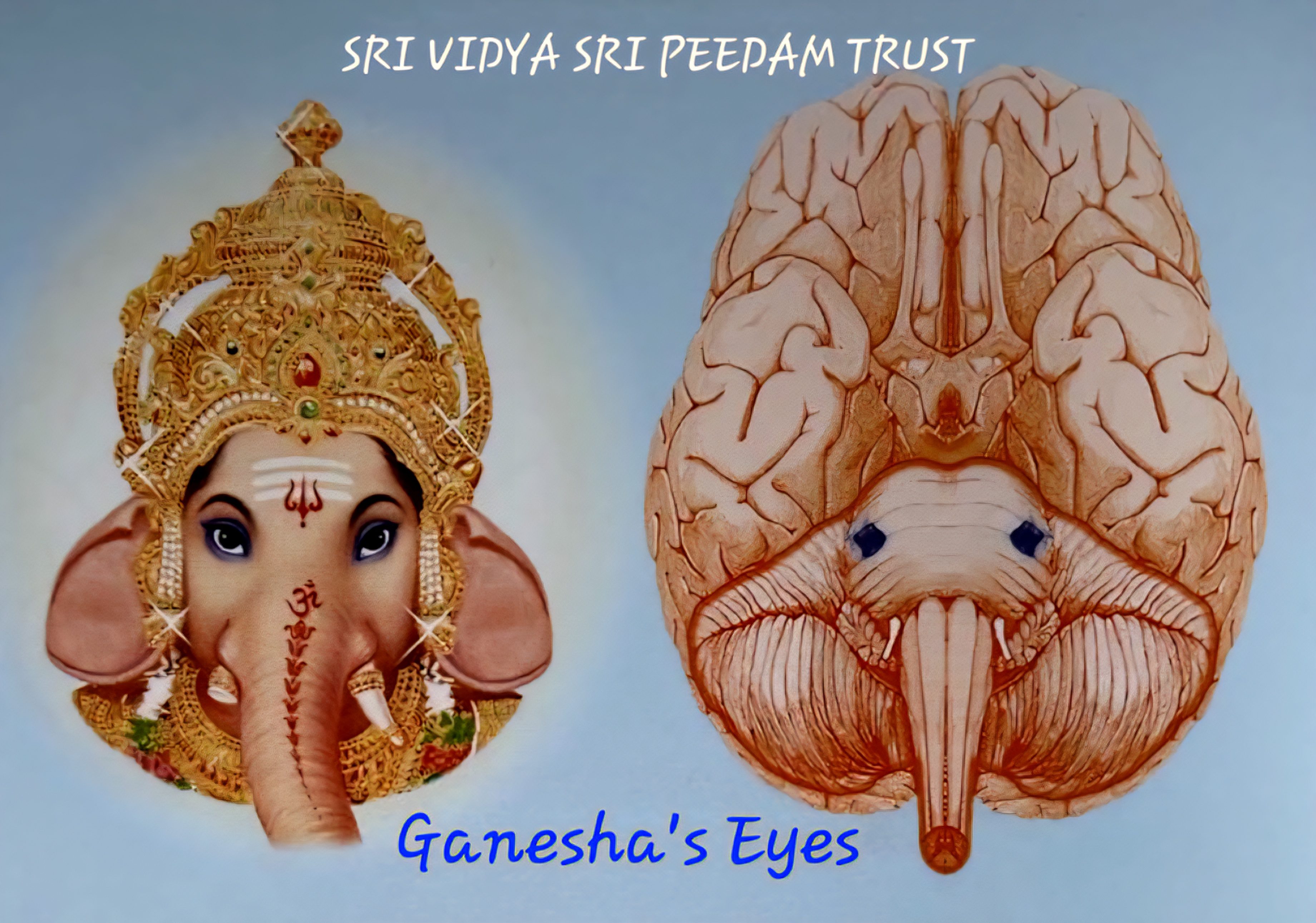
Ganesh’s eyes are the roots of the trigeminal nerve. They are conductors of sensory information. This is similar to the function of the eyes, which perceive, “code” information received from the environment and transmit it to the brain.
The claim that Ganesha’s eyes are the roots of the trigeminal nerve is not a literal anatomical statement. It’s a symbolic representation found in a specific interpretation of the Hindu god Ganesha’s form, often discussed in the context of Vedic anatomy and its correlation with the human brain. This interpretation, which likens the ventral view of the brain to Ganesha’s form, suggests that the roots of the trigeminal nerve, which are located near the pons, correspond to the god’s eyes.
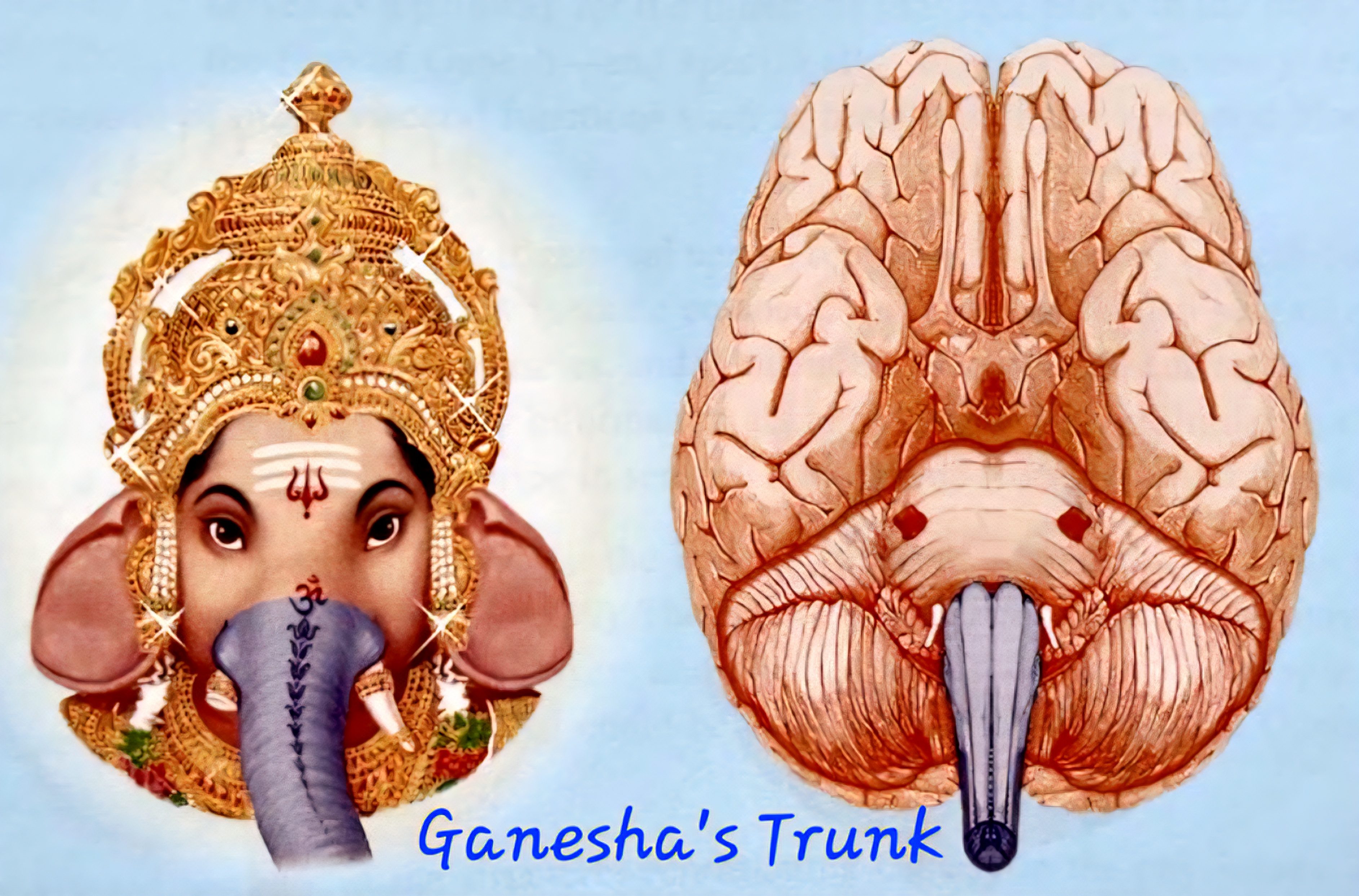
Ganesha’s trunk is the medulla oblongata: The medulla oblongata is the main area that controls many internal functions such as breathing, heart rate, blood pressure.
Medulla Oblongata’s Role: The medulla oblongata is a crucial part of the brainstem, responsible for regulating vital functions such as heart rate, breathing, and blood pressure.
Ganesha’s Trunk’s Symbolism: Ganesha’s trunk is similarly associated with adaptability, strength, and the ability to overcome obstacles.
Functional Parallel: Just as the medulla oblongata is essential for maintaining life and bodily functions, Ganesha’s trunk is seen as a powerful tool for navigating challenges and achieving goals.
Symbolic Connection: The comparison highlights how Ganesha’s form in the nervous system is not merely metaphorical, but also structurally and functionally relevant.
Other Symbolic Correspondences: Extending beyond the medulla, other brainstem components, such as the trigeminal nerves (eyes) and pontine nuclei (tusks), also correlate with Ganesha’s attributes, thereby reinforcing the profound relationship between his iconography and brain function.
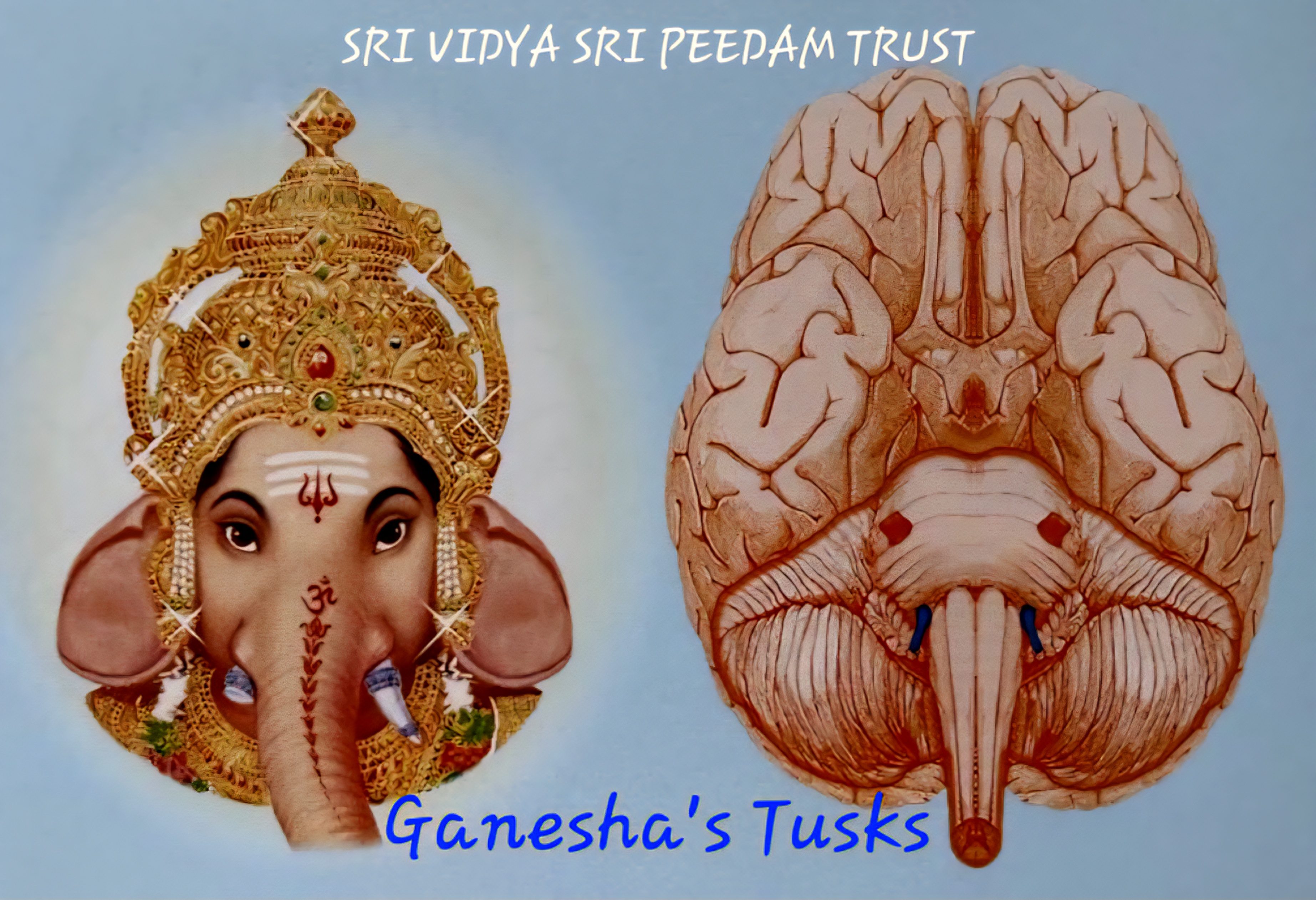
Ganesha’s Tusks: Ganesha’s tusks are a group of nerves at the base of the pons (Varoli bridge). They are responsible for balance and spatial orientation. There is a legend about how Ganesha quickly gained his bearings. Shiva decided that he would be the ruler who circumnavigated the galaxy fastest. Skanda (Shiva’s son) immediately jumped up and began his long journey, and Ganesha leisurely circled his parents, because they, Shiva and Parvati, were the personification of the galaxy.
While the pons (Varoli bridge) is indeed part of the brainstem, and the brainstem is associated with the depiction of Ganesha in some interpretations, the tusks of Ganesha are specifically linked to the trigeminal nerve, not a group of nerves at the base of the pons. The pons itself forms the “face” of Ganesha, while the trigeminal nerve roots are considered to represent the eyes. Here’s a more detailed explanation:
The Pons (Varoli Bridge): The pons is a major structure of the brainstem, situated between the midbrain and medulla oblongata. It plays a crucial role in relaying information between different parts of the brain and spinal cord, and is also involved in functions like breathing and sleep.
Ganesha’s Depiction: In some interpretations of Hindu iconography, the ventral (bottom) view of the brain is seen as resembling Ganesha.
Specific Correspondences: The pons corresponds to the face of Ganesha. The medulla oblongata represents the trunk. The cerebellum forms the ears. The roots of the trigeminal nerves are associated with the eyes.
Trigeminal Nerve: The trigeminal nerve is one of the cranial nerves, responsible for sensory information from the face and motor control of the muscles of mastication (chewing). The two branches of this nerve, exiting the brain at the level of the pons, are interpreted as Ganesha’s tusks.
Ganesha’s symbolism is also reflected in his mount, a mouse, which symbolizes the ability to overcome obstacles and control one’s desires. In essence, Ganesha’s form, with its various parts and associated functions, serves as a potent metaphor for the human brain and its complex processes
Discover more from SRI VIDYA SRI PEEDAM TRUST
Subscribe to get the latest posts sent to your email.