The Sharira Tattva (Doctrine of Bodies) : The 5 Khoshas & 3 Bodies

Understand the Kośas: Discover the Five Deeper Dimensions of You
“When body, energy, thought, emotion, intelligence, and even bliss can all be observed—who is the one to whom they appear?”
It becomes Self-inquiry.
A living being consists of mind, body, and spirit. The Sharira Tatva (Doctrine of Three Bodies) describes the human body as consisting of three aspects and five sheaths. Yoga philosophy teaches us that the human being is not just a physical body of bones, muscles, and blood, but three complex bodies consisting of multiple layers essential to our existence. We know these layers as the five koshas, and they hold the key to unlocking knowledge of the true Self.
The Three Aspects Of The Body:
According to Yogic philosophy, human beings have three bodies: the physical body, the astral body, and the spiritual body, commonly known as the soul. They are all interconnected via the vital life-force energy, prana. To truly understand the three bodies and their roles, we need to delve a little deeper.
🕳 Sthula Sharira, or the gross physical body, is the physical body through which life is experienced. Its main features include birth, aging, and death. It is related to the waking state. The gross body ceases to exist upon death, becoming one with nature.
Essentially, everything you can see with your eyes or touch with your hands is your physical body. Beyond the surface, the gross body is made up of five primary elements: Earth (Prithvi), Water (Jal), Fire (Agni), Air (Vayu), and Ether (Akasha). That is why we need a daily intake of these five elements to maintain our physical body.
The ancient science of Ayurveda is based on the principle that these five elements must be regularly replenished to keep the body healthy and free from disease. In yoga, we often practice asanas (yoga postures) and meditation to balance the elements and maintain the health and vitality of our physical body.
The physical body is the tool; we need it for doing anything in this physical world. For example, we need a pen to write on a board, but it is not the pen that writes; we write using the pen.
Sukshma Sharira, or the subtle body, houses the mind and vital energies (prana). The subtle body is the bridge between the physical and spiritual bodies. This layer is not visible to the human eye, but is the source of our thoughts, feelings, and actions. The subtle energy channels known as nadis and the chakras lie within this body.
The subtle body is made up of 19 elements in total.
Five Sense Organs: Senses of knowledge (Gyan indriyas): 1. Ear – Shotra (to hear). 2. Eye -Chakshu (to see). 3. Nose – Grahna (to smell). 4. Tongue – Jivha (to taste). 5. Skin – Tvak (to feel).
Five organs of action (Karma indriyas): 1. Hands – Pani, 2. Feet – Pada, 3. Mouth – Vak (organ of speech), 4. Anus, and 5. Genitalia – Payu (Organs of excretion)
Five Pranas (Pancha Vayus): Fivefold vital breath: 1. Prana – Respiration, 2. Apana: Elimination, Detoxification, Grounding, and Stability. 3. Viyana – Circulation & Distribution, Movement and Coordination, Balance and Integration. 4. Samana – Digestion & Assimilation. 5. Udana – Activities .
4 Elements of Antahkarana (inner instruments): 1. Manas (mind), 2. Buddhi (intellect), 3. Subconscious, 4. Ego.
The dream state is a distinct state of this Sharira. The subtle body disintegrates at the time of rebirth, allowing the development of a new personality in the new life.
🕳 Karana Sharira, or the causal body, merely contains the seed of the Sthula and Sukshma Shariras and has no other function. It is the most complex of the three bodies and is thought to be the portal to higher consciousness. It is identified with deep sleep. The causal body incarnates repeatedly with each rebirth, carrying the imprints of past lives (samskaras), and disintegrates only at moksha, or liberation.
The three bodies are also related to the Pancha Koshas (five sheaths), which are layers that envelop the Atman (soul). The Sthula Sharira is primarily associated with the Annamaya Kosha, while the Sukshma Sharira encompasses the Pranamaya, Manomaya, and Vijnanamaya Koshas, and the Karana Sharira is linked to the Anandamaya Kosha.
Significance: Understanding the Sharira Traya and Pancha Koshas is essential for spiritual growth and self-realization. By understanding the nature of these bodies, one can begin to transcend limitations, purify the mind, and ultimately realize their true nature as pure consciousness.
Five Sheaths/Koshas
The Taittiriya Upanishad, a Vedic-era text probably composed in the 6th century BCE, is often considered a principal Upanishad and is embedded in three chapters of the Yajurveda. In this text, we find an allusion to the principles of koshas that make up our individual “being.” This Upanishad expounds that each human being is composed of five koshas, or sheaths of consciousness, which envelop the atman and act as veils of illusion, preventing us from seeing the true nature of our self. Each sheath is made up of increasingly finer shades of energy, beginning from the outermost layer to the innermost spiritual core of our being. These five layers interpenetrate each other and become progressively subtler, going from the gross and tangible to the most subtle and intangible.
It is possible to slowly and mindfully move through these five layers of illusion to realize our true essence using spiritual practices. We can only see the Annamaya Kosha, as it is made of physical matter. The other four sheaths are purely energy states, which, though not visible to us in shape or form, are perceptible when we focus our attention on them. It is imperative to ensure that the five koshas are kept well-nourished, as they impact our well-being throughout our lives and are believed to transport our energy to the next incarnation after the death of our physical body.
■ Anandamaya Kosha as ether or space.
■ Vijnanamaya Kosha as air
■ Manonmaya Kosha as steam
■ Pranamaya Kosha as water,
■ Annamaya Kosha as ice.
Sri Vidyaranya Parabrahma Maha Siddha Guru Managurunathan
Annamaya Kosha
The outermost layer is the Annamaya Kosha, which means “food-body” and represents our gross physical body, or Sthula Sharira. This layer comprises skin, bones, connective tissues, muscles, organs, blood, etc. It is associated with the earth element and closely relates to our body type, weight, a propensity for specific ailments, and disposition toward certain kinds of food. The word “anna” refers to “food” that our body takes from the earth and eventually returns to after death, becoming food for other organisms. This sheath is affected by the samskaras in the food we consume. The nature of this kosha is that it is mortal, and hence, it is subject to birth, decay, and death. This layer is one with which we find ourselves preoccupied most of the time, pursuing physical gratification and enjoyment.
This kosha benefits significantly from: ○ Consuming sattvic food and drink. ○ Practice of asana: Any form of physical activity. ○ Mindful eating. ○ Healthy sleep habits. ○ Herbs and supplements. ○ Spiritual Massage. ○ Natural clothing. ○ Maintaining a healthy inner and external environment.
Pranamaya Kosha/Energy Body
This is the sheath of prana (Energy), the Sanskrit word for breath, life force, or vital principle, that permeates reality at all levels, including inanimate objects. Prana is responsible for the movement of bodily fluids such as blood, lymph, and cerebrospinal fluid, and the circulation of breath through the respiratory system. This energy body, which makes up our sukshma sharira, is the first non-tangible layer we encounter, forming a bridge between the physical and energy bodies. We cannot see this energy but can perceive it in our bodies. When prana exits the body, all bodily functions cease, and cell disintegration begins.
Types of Pranas
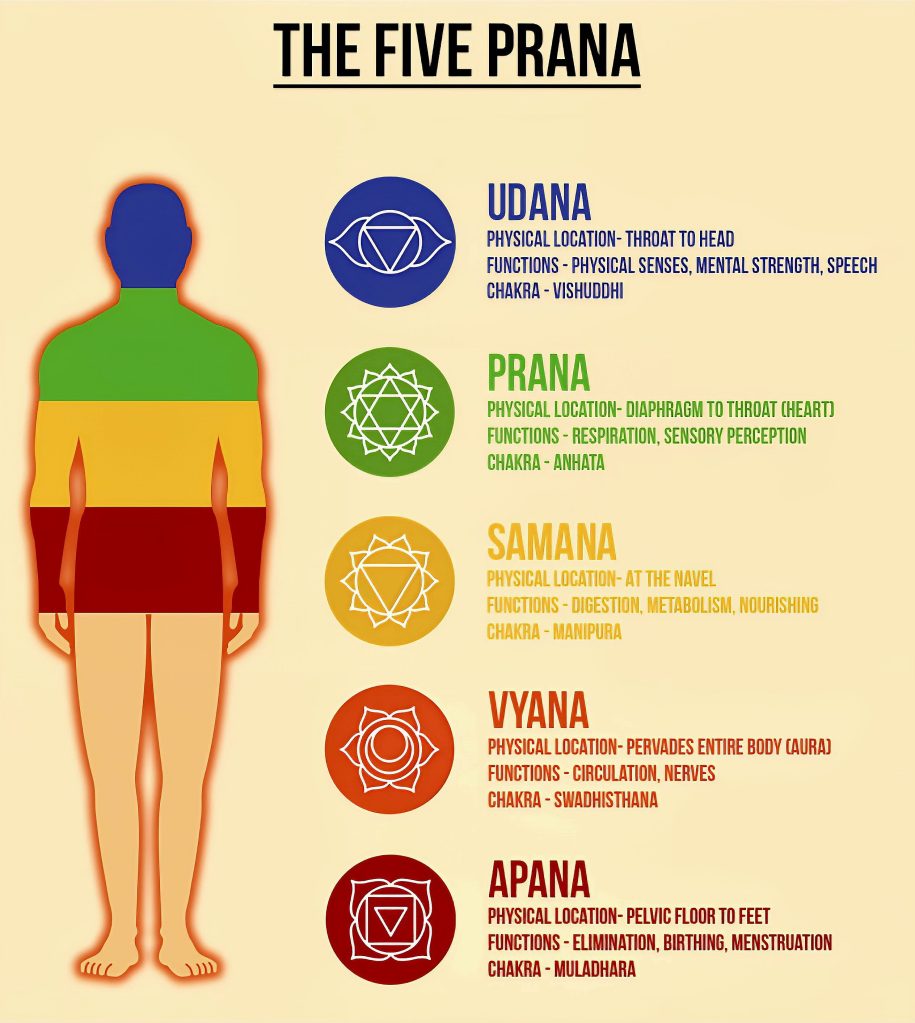
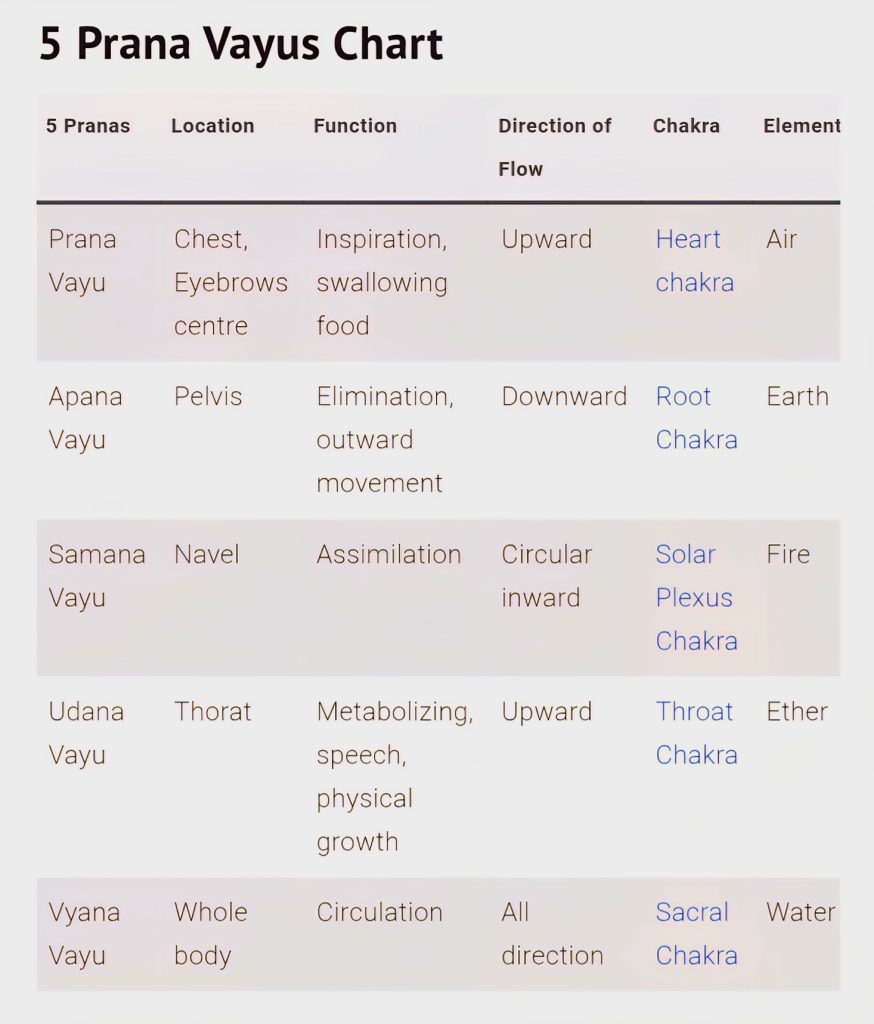
Five types of prana, collectively known as the five vayus (winds), are described in Vedic texts.
● Prana-Vayu, translating as “inward-moving air,” is the fundamental energy in the body that directs the other four vayus. Prana vayu is responsible for the workings of the respiratory system, including the pumping of the heart and the primary inhalation-exhalation process. In addition, it assists in swallowing and regurgitating food. It balances some physiological and psychological activities, such as eye concentration, emotions, and mental consistency.
The heart chakra is said to be the main seat of this vayu, and its associated element is air. Therefore, an imbalance in the quantity or a blockage of prana vayu can lead to depression, low feelings, and heart-related problems.
Poses: To balance prana vayu, one can practice asanas that primarily involve the chest region. Some examples of asanas to balance prana vayu are Standing Cobra, Bridge Pose, Bow Pose, and Camel Pose.
The pranamaya kosha benefits from: ● Fresh Air, ● Sunlight, ● Prana-rich foods, ● Pranayama, ● Meditation-practice, ● Mudras, ● Rituals, ● Chakra Visualization.
● Apana-Vayu is a downward and outward flow of energy in the body. It is responsible for elimination, and its mental function is related to the ego. Apana Vayu is also responsible for sexual stimulation, ejaculation & monthly menstrual cycle for women.
Apana vayu flows in the opposite direction of prana vayu, downward. Generally, pranayama aims to redirect apana vayu to higher energy centers and restrict its unnecessary outflow. Its location is the Muladhara Chakra and Earth element.
The major working area of apana vayu is the core of the pelvic floor, regulating the organs between the navel and the perineum, such as the urinary system, reproductive system, kidneys, and large intestine. An imbalance in apana vayu can lead to diabetes, stomach problems (from poor elimination), laziness, tiredness, itching, depression, and negativity.
To balance apana vayu, one should focus on poses that cultivate awareness near the root chakra. For example: Tree Pose, Bound Angle Pose, Locust Pose, etc.
● Samana-Vayu is the equalizing air that governs the digestion, absorption, and assimilation of all substances—food, air, experiences, emotions, and thoughts.
Samana means “equal” (equal in the sense of balancing). It is located between the working areas of prana and apana vayu. It has no movement in an upward or downward direction but works only in the navel region. Samana vayu focuses on the body’s “fire element” and hence stimulates the Manipura Chakra. It is responsible for the energy utilized in the digestion process and the working of digestive organs like the stomach, liver, and large intestine. Samana vayu is both heating and cooling in nature, which regulates the digestion process. An imbalance of Samana Vayu can disturb a person’s appetite, which brings weakness to the body. Moreover, it affects metabolism and causes deficiencies in the body.
Poses that creates extension or contraction in the navel region are good to balance the samana vayu. For example, Boat pose, Seated forward bend pose, etc.
● Udana-Vayu is the ascending air that channels the flow of prana from the lower to the upper parts of the body. Its action is metabolization. It governs speech and expression. This vital energy lies in the vishuddha chakra (throat) and the limbs above it. Associated elements are ether.
On the physical level, Udana Vayu coordinates the neurons of the motor and sensory nervous systems. This coordination facilitates the proper movement of the body’s organs. Additionally, it controls the five physical senses. Udana Vayu works in various regions of the body, residing between the neck and head, shoulders and fingertips, and hips and toes.
The deficiency of Udana Vayu can make a person paralyzed. Senses of the body won’t work correctly & it can lead to vision problems and deafness.
Poses that bring awareness to the shoulder and head region are best to balance the udana vayu in the body. For example, Bridge Pose, Shoulder Stand, Plow Pose, Fish Pose, etc.
● Vyana-Vayu is the diffusing air whose movement is outward. It governs circulation on all levels and is pervasive and expansive. It is responsible for the distribution and movement of all substances throughout the body and assists the other vayus in their functions. This vayu’s action is circulation. Its associated energy center is the Sacral Chakra (Swadhisthana), and its element is water.
Unlike the other four pranas, vyana vayu has no specific working area in the body, as it travels throughout the body and mind through the circulatory system. An imbalance in vyana vayu can lead to a lack of coordination between sensory and motor neurons, resulting in weak or tight muscles. Also, a deficiency of this vayu can cause excessive sweating and sudden horripilation due to fear.
Poses to balance Vyana Vayu, such as Half-Moon Pose and Eagle Pose, can be practiced to redirect Vyana Vayu to a different part of the body.
Upa-prana / Sub-vital airs
Apart from the 5 major vayus, there are 5 minor pranas also, called Upaprana. 5 upa pranas are Naga, Kurma, Krikala, Devdatta, and Dhananjaya.Whenever there comes blockages in 5 main prana vayus, upa-pranas works to bring that vayu in balance. Also, it is responsible for routine activities like eye blinking, yawning, sneezing, or burping, etc.
● Naga – Releases gas causing blockage in Prana and Apana Vayu, manifesting as burping, vomiting, hiccups, etc. It is considered a vital force maintaining the balance of other pranas by managing excess air release from the digestive system.
Function: Naga Vayu’s primary role is expelling air from the body, primarily through belching and hiccups. It also triggers the vomit reflex when the body needs to eliminate substances due to indigestion.
Relationship to Other Pranas: It is closely linked to Samana Vayu, which governs digestion and metabolism. When Samana Vayu is imbalanced, Naga Vayu may be activated to resolve digestive issues by expelling excess air.
Beyond Digestion: Some interpretations suggest Naga Vayu also influences other bodily functions like salivation and even plays a role in consciousness and concentration, particularly in meditation where its activity is reduced.
Importance in Health: Proper Naga Vayu functioning is important for maintaining digestive health and preventing discomfort from trapped air. Imbalances can lead to excessive belching, hiccups, or digestive issues.
● Kurma – This upa-prana controls eyelid winking and keeps the eyes moisturized. Kurma Vayu is also believed to influence the stability of the mind and concentration during meditation.
Key aspects of Kurma Vayu:
Eye Function: Kurma Vayu directly controls the movement of the eyelids, allowing for blinking and keeping the eyes healthy, moist, and protected from dust and debris.
Connection to Nadi: It is associated with the Kurma Nadi, a subtle energy channel in the body, believed to be located in the chest below the throat.
Mental Stability: Kurma Vayu is thought to play a role in stabilizing the mind, particularly during meditation, by promoting focus and concentration.
Balance and Harmony: In Ayurveda, the proper functioning of Kurma Vayu contributes to overall balance and well-being by ensuring healthy eye function and mental clarity.
Potential Imbalance: An imbalance in Kurma Vayu can manifest as excessive blinking, dry eyes, difficulty concentrating, or restlessness during meditation.
● Krikala – It induces sneezing to clear respiratory system blockages. Krikala Vayu is particularly associated with clearing respiratory blockages, often manifesting as sneezing. It is also linked to yawning, hunger, and thirst.
Origin and Control: The origin of Krikala Vayu is linked to sloth and lethargy. Controlled practices, such as specific yoga and pranayama techniques, can help overcome these, potentially leading to decreased hunger and thirst, and even a flow of sweet secretions in the mouth.
Relationship to the Major Pranas: Krikala Vayu, along with the other four Upa-Pranas (Naga, Kurma, Devadatta, and Dhananjaya), works in conjunction with the five major Pranas (Prana, Apana, Samana, Udana, and Vyana) to maintain overall bodily function and vitality.
● Devadatta – This upward-moving prana releases gas in the form of yawning. It balances samana vayu energy by expelling gas after eating.
Yawning: Devadatta Vayu is known for its role in causing yawning. Yawning is a natural bodily function that helps expel accumulated carbon dioxide and take in fresh oxygen.
Exertional Fatigue: It helps relieve tiredness, particularly after eating. Certain foods, like grains, onions, and garlic, can cause fatigue, and Devadatta Vayu helps counter this by expelling gas and providing the body with more oxygen.
Relationship to Samana Vayu: Its function is similar to Samana Vayu, which is responsible for digestion and the assimilation of nutrients.
Balancing Breath: By controlling Devadatta Vayu, practitioners can improve their ability to regulate breath and overcome lethargy.
Connection to Subtle Body: Devadatta Vayu, like the other pranas, is considered a subtle energy flow that influences the body’s physical and mental health.
● Dhananjaya – It regulates the opening and closing of the heart valves and controls the fragmentation of a body after death. Associated with the body’s natural decomposition process, it is considered the last to leave after death. It influences the muscles, arteries, veins, and skin, particularly regarding touch and swelling after injuries.
Dhananjaya Vayu also plays a role in the body’s subtle movements, like twitching.
Key Characteristics of Dhananjaya Vayu:
Last Prana to Leave: It is believed to be the last of the five subtle energies (pranas) to leave the body after death and is responsible for the body’s decay.
Decomposition: It is directly involved in the process of decomposition; this is why the body might sometimes exhibit movements or sounds after death.
Influence on Touch: Dhananjaya Vayu is linked to the sense of touch, and its activity can be felt in various parts of the body, including the muscles and skin.
Swelling and Injury: Swelling after an injury is often attributed to the activity of Dhananjaya Vayu.
Twitching and Trembling: This subtle energy is also associated with twitching and trembling movements in the body.
- Each vayu governs a specific area of the body and ideally functions in harmony with one another. Their subtle energetic movements affect and influence our physical, emotional, and mental health and well-being. If a vayu becomes imbalanced, it can create disharmony throughout the body’s energetic system or negatively affect its associated chakra or the organs linked to its location. Poses such as Surya Namaskara are wonderful practices to balance all vayus.
The pranamaya kosha benefits from: ● Fresh air. ● Sunlight. ● Foods are high in prana. ● Pranayama ● Meditation. ● Mudras. ● Rituals. ● Chakra Visualization
Manomaya Kosha/Mental Body
This is the sheath of the mind and includes our emotions, feelings, and workings of the nervous system. It involves processing inputs through our five senses and responding to them reflexively, without conscious application of focus. Our thoughts, fantasies, and daydreams constitute this kosha, as they are all methods of making sense of the outside world. On the most basic level, we are talking about perceptions, images, and emotions, but at a deeper level reside our prejudices, preconceived notions, and beliefs that we absorb over a lifetime.
This kosha benefits from: ■ Mantra japa, ■ Meditation ■ Kirtan ■ Satsang
Guruji says: “We tend to have the most imbalance in our Manomaya kosha; through the powerful practice of mantra, we can work beyond the gross layer of the body and into our mind-body.”
Vijnanamaya Kosha/Intellectual Body
This is the sheath of wisdom or the psyche. Sensory perceptions coming from the Manomaya Kosha are processed here, and meaning is imbued into them with awareness, insight, and consciousness. Here, we make choices about every aspect of our lives based on our experiences so far. This sheath can be seen as the one housing our intelligence as we engage in activities that help us gather wisdom through conscious awareness.
This kosha benefits from: ● Chakra Visualization, ● Meditation, ● Yantra Gazing, ● Seva (Service to others).
Anandamaya Kosha/Bliss Body
Among the five sheaths, the Anandamaya Kosha reflects the divine consciousness and its state of satchidananda (eternal bliss). This is the sheath of bliss as we move from conscious awareness to pure bliss. In this sheath, there is nothing but sheer joy and utter contentment. There are no mortal fears or base emotions such as anger, jealousy, and insecurities.
This layer is closest to the intangible and immortal atman. We can access this layer through dedicated spiritual practice. The fact that each of the koshas is suffixed with the word “maya” (illusion) points to their illusory nature. They may appear to separate us from the divine consciousness, but that is illusory. The Vedic texts have left us a clear message that even though we point out all these differences, we are not separate from the Divine.
To understand the development of the process by which energy condenses from the unmanifest to the gross physical form of the human body, we can think of the Anandamaya Kosha as ether or space, Vijnanamaya Kosha as air, Manonmaya Kosha as steam, Pranamaya Kosha as water, and Annamaya Kosha as ice. Just as it is more difficult to give shape to ice than to water (as ice is solid and water a liquid, taking on the shape of its container more readily than ice), the more ephemeral the various sheaths become as we move towards the higher realms.
Guruji says: “When you know how it feels to be fully present in your physical sheath, rather than floating through life dissociated from it, you will find yourself more centered and sane, less prone to accidents, and more intuitively tuned in to which foods and activities nourish the body. When you can touch the subtle power of expansion and healing in the vital energy sheath, you can move stuck energy, release your own vitality, and connect to the energy in nature and others. When you acknowledge your mental sheath, you can note the effect of certain thoughts and step out of the trance-like states that arise when you blindly accept thoughts and emotions. Access your wisdom sheath, and you’ll find that you have more clarity and intuition to keep your life on track. And each time you get in touch with the bliss sheath, you fall into the fundamental goodness of life.”
12 Layers of the Body
Various traditions of energy healing and spiritual teachings describe twelve layers of the human energy field. These layers, also termed energy bodies or subtle bodies, represent non-physical aspects of our being. Each layer uniquely contributes to overall well-being, reflecting the complexity of human existence.
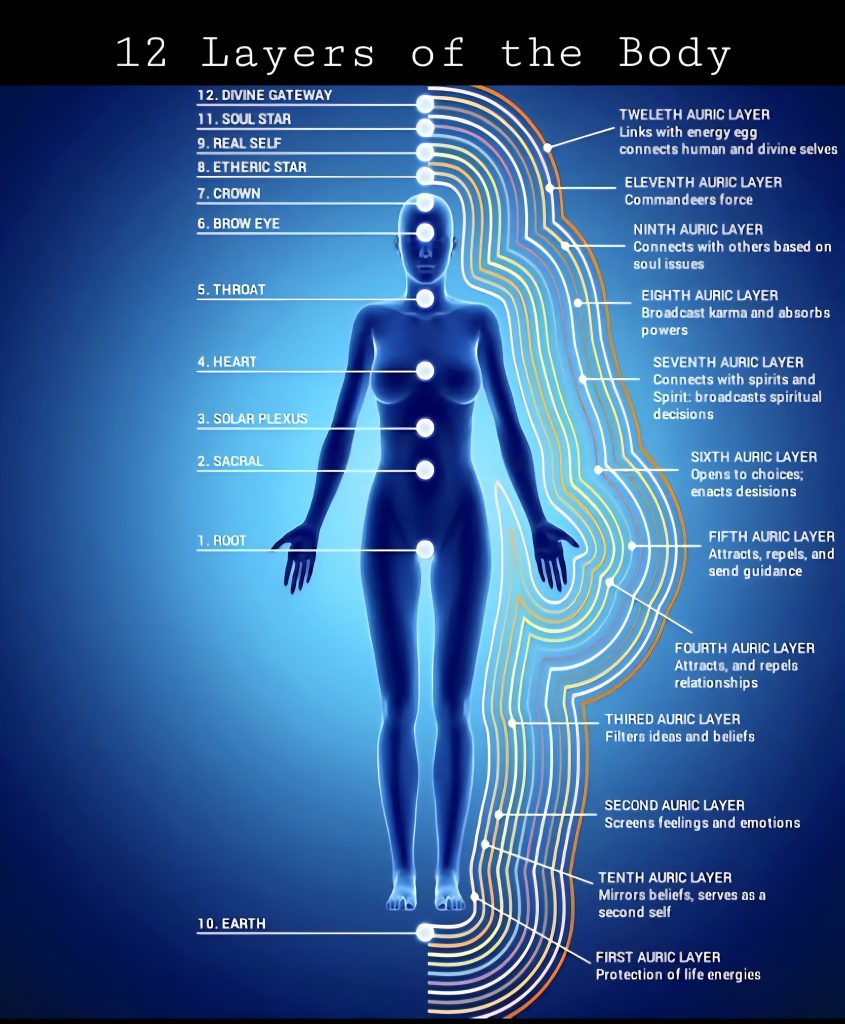
Exploring the 12 Layers:
- Physical Layer: The tangible, material body consisting of bones, muscles, organs, and cells; it’s the vehicle through which we experience the physical world.
- Etheric Layer: The first layer of the aura, serving as the blueprint for the physical body, is often seen as a web of energy that sustains and vitalizes the physical form.
- Emotional Layer: The seat of our feelings and emotions. This layer holds emotional patterns and experiences that influence our mood and emotional health.
- Mental Layer: Responsible for thoughts, beliefs, and cognitive processes; it shapes our perceptions and mental clarity.
- Astral Layer: The bridge between the physical and spiritual realms, associated with our dreams, imagination, and astral travel.
- Etheric Template Layer: A higher vibrational duplicate of the physical body, providing a template for the etheric and physical layers.
- Celestial Layer: Associated with our connection to the divine, higher consciousness, and spiritual enlightenment, the celestial layer is where we experience unconditional love and bliss.
- Ketheric Template Layer: The outermost aura layer, containing our soul’s purpose, karmic patterns, and divine blueprint, encompassing the totality of our existence across lifetimes.
- Akashic Records Layer: The energetic library of our soul’s history, holding records of all our thoughts, actions, and experiences throughout all our lifetimes.
- Memory Layer: This layer stores imprints of our personal and collective memories, affecting our behaviours and reactions based on past experiences.
- Experiential Layer: Integrates the learnings from our life experiences, aiding in personal growth and the application of wisdom gained over time.
- Spiritual Core Layer: The essence of our being, representing our true self and our connection to the universal consciousness, is often seen as the source of our spiritual power and intuition.
Why Understanding These Layers Matters:
A deeper understanding of these twelve interconnected layers can greatly enhance our approach to healing and personal growth. Imbalances in one layer may affect the others. Energy healing practices can help harmonize and balance our entire being, fostering well-being and spiritual growth.
Exploring the Twelve Layers on Your Healing Path: As you progress on your journey of self-discovery and healing, consider exploring each of these twelve layers to gain a deeper understanding of your existence. Whether you practice Reiki, meditation, or other energy work, awareness of these layers can enrich your practice and enhance your well-being. By delving into the concept of the twelve layers, we can better appreciate the complexity and beauty of our multidimensional selves, recognizing that feelings of discontent or unrest are part of a larger, intricate system that defines us.
Discover more from SRI VIDYA SRI PEEDAM TRUST
Subscribe to get the latest posts sent to your email.